The 2 Change Strategies Of Effective Organizations
The Core Idea
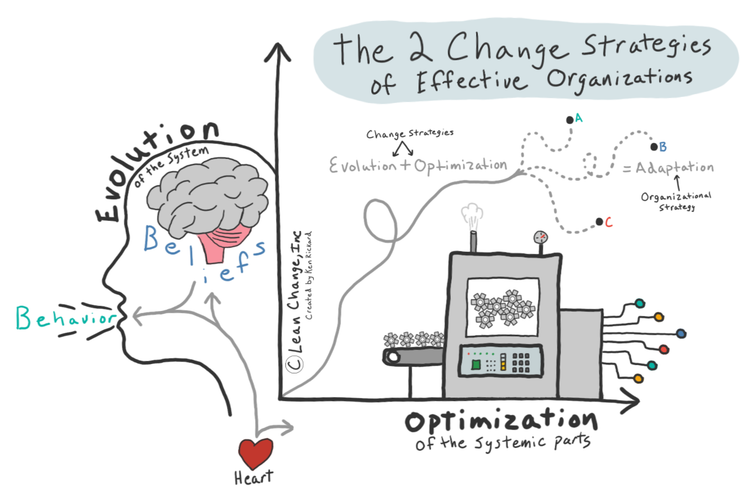
Organizations improve in two fundamentally different ways:
Optimization (horizontal improvement): make the current system work better within today’s beliefs and mental models.
Evolution (vertical growth): become more effective by outgrowing today’s beliefs and mental models. This changes how the organization thinks, decides, and learns.
If you remember nothing else: Optimization improves the system you have. Evolution changes the kind of system you are. Adaptability requires being able to do both on purpose.
The Model
A simple equation captures real adaptability:
Evolution + Optimization = Adaptation
A quick orientation:
Optimization keeps the operating worldview mostly intact and improves performance inside it.
Evolution upgrades the operating worldview, often reshaping structures, decision rights, and learning habits.
Signal Vs Noise
Signals (You’re Probably In The Right Model)
Your improvements are hitting diminishing returns even though the team is working hard.
The environment is shifting (customers, competitors, regulation, technology) and the current playbook is getting brittle.
You keep “fixing delivery” but the same constraints (approvals, priorities, incentives) keep reasserting themselves.
Noise (Common Misreads And Traps)
Treating new tools as transformation (“we moved to the cloud, therefore we are digitally transformed”).
Confusing reorg activity with improvement (“reorg trash” without better outcomes).
Believing that upgrading mental models is a substitute for execution (it isn’t).
Optimization (Horizontal Development)
Optimization is improvement that stays inside the current operating worldview. It’s the organization becoming better/faster/cheaper without changing its underlying assumptions.
Typical examples:
Process tweaks, efficiency plays, tooling upgrades
Streamlining handoffs, reducing cycle time, tightening governance
Predictable failure modes when you over-rotate:
Making the current system more efficient after the market has moved on
Optimizing one lever (often technology) while ignoring how it reshapes strategy/structure/process/people
Declaring “done” because the process and tools changed
Evolution (Vertical Development)
Evolution is improvement that requires changing the organization’s worldview, including its beliefs, mental models, and often its structures.
The aim is to operate from a more adaptive posture. That means leading, learning, and deciding differently so the organization can handle the volatility and complexity it faces.
Typical examples:
Redistributing decision rights and accountability to the edges
Building leadership and learning practices for the “next wave,” not just the current system
Changing how the organization makes sense of reality and adapts to it
Predictable failure modes when you over-rotate:
Too many bets without the operational discipline to sustain them
Chasing the new thing while starving the core of attention and follow-through
How The Two Strategies Work Together
Adaptive organizations deliberately build the capacity to toggle between evolution and optimization depending on what the context needs.
What that looks like:
Optimize existing bets when the context is stable enough to exploit
Evolve how the organization senses/responds when the context is turbulent enough to explore
The better you combine both, the more likely you are to steer intentionally instead of drift.
What This Looks Like In The Wild
A company modernizes its tooling and delivery pipeline (optimization) and sees an initial bump.
Then the work slows again because priorities still change weekly, decision rights are centralized, and teams can’t say “no.” The constraint wasn’t the toolchain. It was how the organization decides.
Optimization move: improve delivery mechanics.
Evolution move: redesign decision rights, clarify accountability, and create a learning loop that stabilizes priorities.
How To Use It In Your Role
Leaders
Name which mode you’re in right now (optimization or evolution) and why.
Protect the system from “either/or” thinking: most failures come from over-rotating.
Align the other levers to the mode you picked (structure, process, technology, people).
Change Practitioners
Diagnose whether you’re solving a performance problem (optimize) or a posture problem (evolve).
Watch for “transformation by two levers” and make the tradeoffs visible.
Design the smallest evolution move that changes how decisions and learning actually happen.
Team Leads And Managers
Translate strategy into local operating rules: what can teams decide without escalation?
When improvement stalls, ask: are we at the edge of our worldview?
Keep optimization work from becoming permanent “efficiency theater.”
Individual Contributors
Notice where the system makes good work hard (handoffs, approvals, unclear priorities).
Offer two kinds of suggestions: one that improves the current system, one that challenges an assumption.
Learn to spot when “more effort” is being used to avoid “different thinking.”
Personal Life
This isn’t therapy, but the lens transfers.
Optimization: improve within your current assumptions (habits, routines, tools, scheduling).
Evolution: upgrade an assumption (what you believe you must control, avoid, prove, or protect).
A practical prompt: “Am I trying to fix my calendar when what really needs to change is what I say yes to?”
Related Big Ideas
The 5 Levers Of Change (what you pull to optimize vs. evolve)
The 5 Waves Of Transformative Change (why evolution often arrives in waves)
The 4 Dimensions Of Change (where shifts must land to stick)
Closing Thought
Most organizations aren’t short on effort. They’re short on clarity about which kind of change they’re actually attempting. Naming the mode is the first act of adaptation.