The 5 Universals Of Change
The Core Idea
Most change gets harder than it needs to be because we push the wrong buttons. We crank urgency, broadcast information, chase buy in, run task plans, then blame resistance when reality pushes back.
The 5 Universals are five tradeoffs that show up in organizations, teams, and personal change. They are not steps. They are a set of lenses for making sense of messy change.
If You Remember Nothing Else: When change gets weird, ask which universal is being violated. The confusion usually makes sense once you spot the tradeoff.
The Model
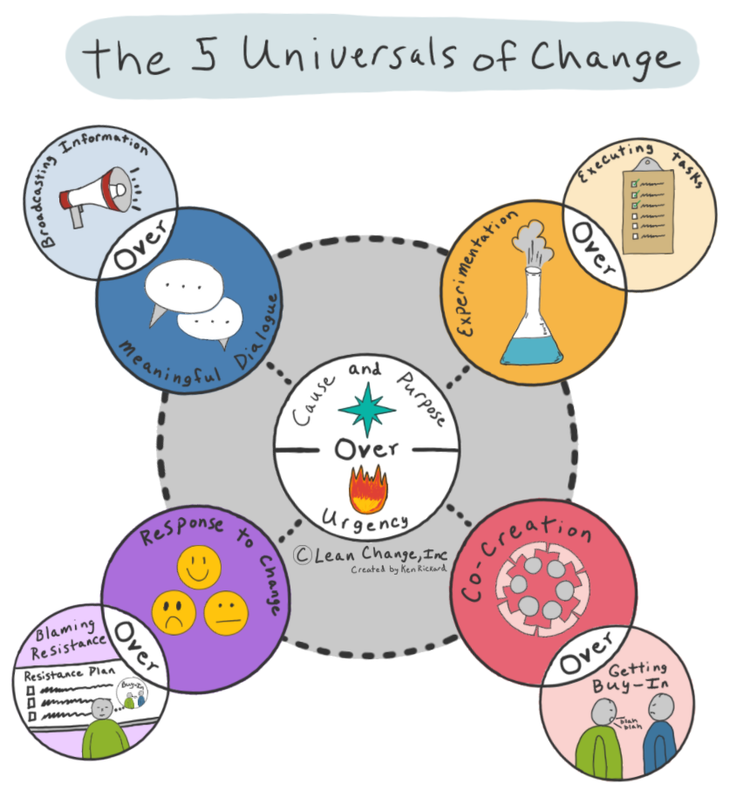
Each universal is a shift from a common default move to a more effective move.
Cause And Purpose Over Urgency
Meaningful Dialogue Over Broadcasting Information
Co Creation Over Getting Buy In
Experimentation Over Executing Tasks
Response To Change Over Blaming Resistance
Signal Vs Noise
Signals
You are likely dealing with a universal mismatch when you notice patterns like these:
The change is moving fast, but energy is low and compliance is high.
Communication is frequent, yet shared understanding is thin.
People are asked to support a decision they did not help shape.
Plans are full of tasks, but learning is absent.
Resistance becomes the main explanation for slow progress.
Noise
Common misreads that add friction:
Treating the universals like soft values instead of operational choices.
Assuming more messaging will fix meaning.
Calling something co creation after decisions are already locked.
Confusing activity with progress.
The Five Universals
Cause And Purpose Over Urgency
Urgency creates motion. Cause and purpose create meaning.
Cause is what is true in the world right now. Purpose is why it matters, and what tradeoffs are worth making. When people can connect cause to purpose, urgency becomes useful instead of exhausting.
When This Gets Violated
The change story is mostly deadlines, pressure, and consequences.
People nod, then quietly revert to the old way.
Fatigue shows up as cynicism, silence, or passive compliance.
Better Moves
Start with what is true, not what is desired.
Make purpose explicit, including the tradeoffs.
Use urgency as a tool, not as the operating system.
Meaningful Dialogue Over Broadcasting Information
Information can be delivered. Meaning has to be made.
Broadcasting pushes messages outward. Dialogue creates shared understanding through questions, reflection, and two way sensemaking.
When This Gets Violated
The same questions repeat in different forms.
Side channel conversations feel clearer than official updates.
People keep asking, "What does this mean for me and my team?"
Better Moves
Replace some announcements with facilitated dialogue.
Use a few consistent questions that help people make meaning.
Make uncertainty speakable instead of pretending it is not there.
Co Creation Over Getting Buy In
Buy in asks people to agree with a decision. Co creation asks people to shape the decision.
Co creation does not mean everyone decides everything. It means the people closest to the work help design the change so it can survive contact with reality.
When This Gets Violated
"We need buy in" shows up late in the process.
Implementation suffers from invisible constraints and local truths.
People feel done to, even when they are polite.
Better Moves
Bring key voices in early, especially the impacted and the skeptical.
Co create guardrails and options, not just a rollout plan.
Make decision rights explicit so participation is real.
Experimentation Over Executing Tasks
Tasks create completion. Experiments create learning.
In a complex environment, plans are hypotheses. Experimentation turns change into a learning system with feedback that can update the approach.
When This Gets Violated
A detailed plan assumes the future is knowable.
Teams optimize for looking on track instead of learning what is true.
New information arrives, but the plan cannot bend.
Better Moves
Turn big unknowns into tiny bets with clear learning goals.
Shorten feedback loops and make results visible.
Protect learning from perfectionism and blame.
Response To Change Over Blaming Resistance
Resistance is often a symptom, not a cause.
A skillful response treats friction as data. It looks for loss, confusion, misalignment, and constraints that make old behaviors rational.
When This Gets Violated
Labels like "resistors" or "blockers" become the explanation.
Control tightens and compliance pressure rises.
The same issues resurface even after strong messaging.
Better Moves
Ask what the system is protecting, and why.
Find the constraint that makes the old behavior sensible.
Respond with clarity, support, and design changes that remove mixed signals.
How To Use This In Your Role
Leaders
When urgency spikes, re anchor the change in cause and purpose.
Trade some broadcast time for dialogue time.
Reward learning, not just delivery.
Change Practitioners
Use the universals as a diagnostic when adoption stalls.
Design participation so it has real influence.
Translate resistance language into system signals you can act on.
Team Leads And Managers
Turn confusion into a visible list of questions and assumptions.
Co create local guardrails so the change fits real work.
Run small experiments and share what you learn across teams.
Individual Contributors
Ask for cause, purpose, and tradeoffs when messages feel only urgent.
Offer to help shape solutions, not just critique.
When you hit friction, describe what is happening in the system rather than who is wrong.
Personal Life
These universals show up in families, friendships, and self change.
Pressure rarely creates lasting change. Meaning does.
Talking at people is different than talking with them.
Shared ownership beats reluctant agreement.
Tiny experiments beat heroic resolutions.
Curiosity beats blame when emotions run high.
Tiny Example
A leader announces a reorg with a tight deadline and a slick slide deck. The message is clear, but teams are confused about decision rights, priorities, and what success looks like. Work slows down. Leaders start calling the slowdown resistance.
A universal read of the situation:
Urgency was high, but cause and purpose were not real for teams.
Communication was frequent, but dialogue was thin.
Teams were asked to buy in after key decisions were already made.
The rollout followed tasks, not experiments, so learning arrived late.
A better next move is not louder messaging. It is a short cycle of dialogue, co creation of guardrails, and a few tiny experiments that stabilize how decisions and work will flow.
Related Big Ideas
The 2 Change Strategies Of Effective Organizations (when to optimize, when to evolve)
The 5 Levers Of Change (what to move when the system resists)
The 4 Dimensions Of Change (where shifts must land to stick)
Closing Thought
The universals do not remove complexity. They reduce surprise. When you work with these tradeoffs on purpose, change becomes less mysterious and far more human.