
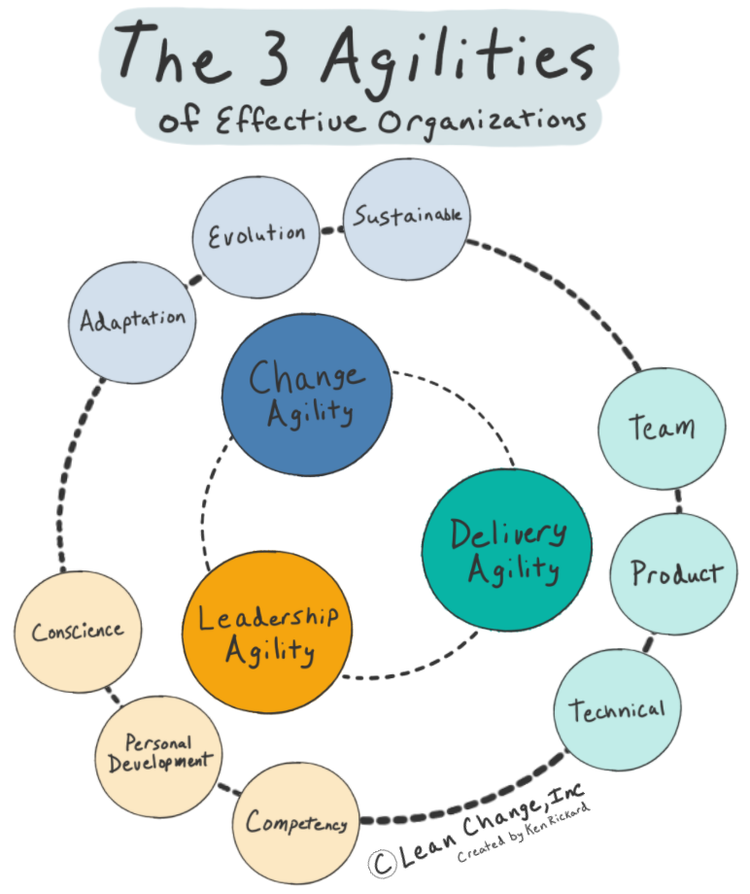
The 3 Agilities Of Effective Organizations
The Core Idea
Agility is not a manifesto, a framework, or a set of rituals. Agility is a characteristic of people and systems.
Effective organizations build three different agilities that work together. They treat readiness as something the organization practices, not something it declares.
If You Remember Nothing Else: Readiness lives in three behaviors. How you lead, how you adapt, and how value flows.
The Model
The three agilities keep three things in the same conversation:
Decision speed
Learning rhythm
Customer impact
The agilities are:
Change Agility (how the system adapts and evolves)
Leadership Agility (how leadership is distributed and developed)
Delivery Agility (how value reliably flows)
Signal Vs Noise
Signals
The organization can ship, but it cannot adjust when the environment shifts.
Teams are asked to be agile, but decision-making remains centralized and slow.
A change initiative creates motion, yet the system keeps snapping back.
People keep arguing about process, when the real constraint is leadership or learning.
Noise
Equating agility with tools, ceremonies, or a single delivery method.
Measuring agility only by output, without looking at decision speed and learning.
Treating leadership development as optional while asking teams to move faster.
The Three Agilities
Change Agility
Change agility is a characteristic of the people who make up an organization. It is the ability to adapt in the short term and evolve in the long term so the system can thrive in dynamically shifting, complex environments.
What It Looks Like:
The organization can change direction without collapsing into chaos.
Learning is built into the work, not bolted on after.
The system updates its beliefs and behaviors when reality changes.
Leadership Agility
Leadership agility is the ability of people, regardless of position or function, to develop themselves consciously and competently in ways that make information widely available and distribute decision-making appropriately across a dynamic change environment.
Two anchors in this model:
Conscience and personal development (awareness, reflection, growth)
Competency (the ability to perform and enable performance)
Delivery Agility
Delivery agility is the result an organization gains by enabling its people, teams, and products to adapt their strategies, structures, processes, and technologies to address a dynamically shifting change environment.
Delivery agility shows up as:
Value flowing with fewer bottlenecks
Teams adjusting workflows and outputs as customer needs change
Products improving through feedback, not just through plans
How The Three Agilities Reinforce Each Other
Delivery agility without leadership agility often becomes fragile. The system can move, but it cannot decide well.
Leadership agility without change agility becomes performative. People talk about growth, but the system does not evolve.
Change agility without delivery agility becomes abstract. The organization can rethink itself, but cannot turn learning into outcomes.
How To Use This In Your Role
Leaders
If you want faster delivery, start by improving decision speed and clarity.
Distribute leadership on purpose. Centralized control and agility do not coexist for long.
Ask one question in every change: What will we learn, and how will we decide based on it.
Change Practitioners
Diagnose which agility is missing before you propose solutions.
Avoid “process only” transformations. They create motion without readiness.
Design learning loops that change behavior, not only understanding.
Team Leads And Managers
Make decision rights explicit. Ambiguity forces escalation.
Protect time for reflection and learning in the workflow.
Watch where the system punishes adaptation. That is where agility dies.
Individual Contributors
Notice whether constraints are coming from process, structure, or decisions.
Ask for clarity on what can be decided locally.
Treat experiments as a normal way of working, not as a special event.
Personal Life
This model transfers because personal change also requires leadership, adaptation, and delivery.
Leadership agility is self-leadership. Awareness and competence both matter.
Change agility is your ability to adapt habits and evolve beliefs over time.
Delivery agility is follow-through. It is how value flows into your day.
A practical prompt: “Am I trying to optimize output, when the real issue is decision speed or learning rhythm?”
Example: What This Looks Like In The Wild
A company adopts Scrum and rolls out a new toolchain. Delivery improves for a moment, then stalls. Priorities keep changing, approval paths remain slow, and teams cannot make local decisions.
The model makes the mismatch visible:
Delivery practices changed, but leadership agility did not.
Learning rhythm stayed weak, so the system kept repeating the same mistakes.
Decision speed stayed slow, so agility existed only at the team level.
The next move is not another process tweak. The next move is distributing decision rights, increasing learning loops, and aligning the system so delivery agility can survive.
Related Big Ideas
The 5 Levers Of Change (what to align when one agility is missing)
The 2 Change Strategies Of Effective Organizations (when to optimize, when to evolve)
The 5 Universals Of Change (how to shift the way change is led)
Closing Thought
Agility is easiest to fake when it is treated as a method. It becomes real when leadership, change, and delivery reinforce each other under real pressure.