The 4 Dimensions Of Change
The Core Idea
Most organizations try to make change work by picking a method and pushing harder. That can create motion, but it does not reliably create adaptation.
Change is both art and science. The art is knowing when and how to intervene. The science is having models and practices that help you see and shape the system.
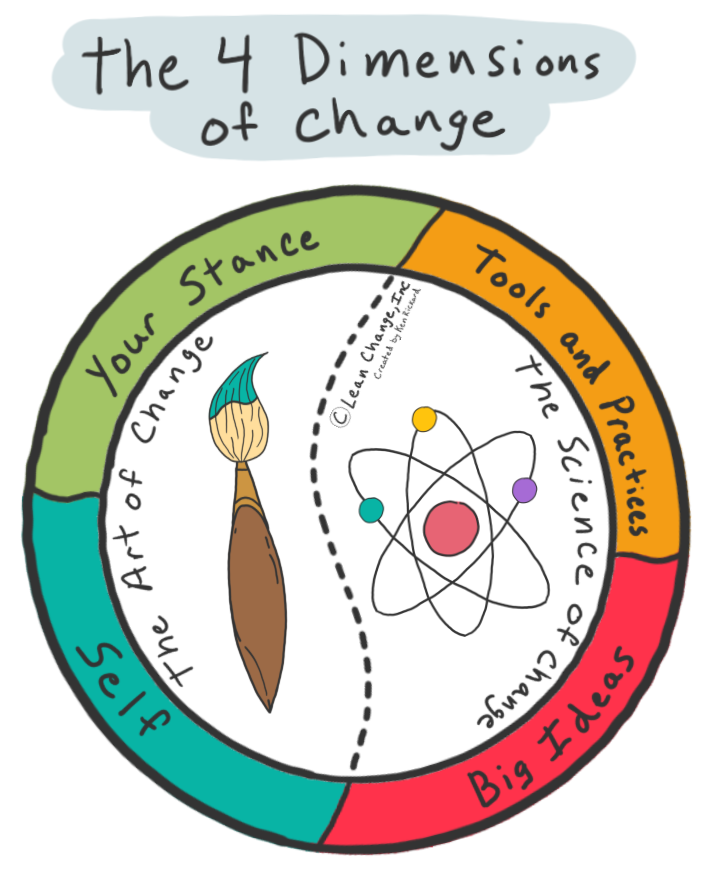
The 4 Dimensions describe what actually drives change effectiveness: who you are, how you show up, the ideas you use to make sense of reality, and the tools you use to facilitate change.
If You Remember Nothing Else: A tool cannot save you from your stance, and a great idea cannot save you from how you apply it. Change runs through the human.
The Model
The four dimensions are:
Self (who you are, and how you interpret the world)
Stance (how you show up, and what impact you create)
Big Ideas (the mental models you use to make sense of the system)
Tools And Practices (the methods you use to facilitate movement and learning)
Signal Vs Noise
Signals
You are likely missing a dimension when you notice patterns like these:
A well designed workshop or framework produces little change once people go back to work.
The same tool works great in one team and fails in another.
People argue about the method, but the real issue is trust, control, or decision rights.
Change agents are exhausted because everything depends on pushing harder.
Noise
Common misreads that keep change stuck:
Believing the next tool will fix a stance problem.
Treating resistance as a people problem when it is often a system signal.
Confusing expertise in change tools with readiness to lead change.
The Four Dimensions
Self
Self is who you are as a human. It includes your beliefs, experiences, and the way you interpret what is happening around you.
Self Shows Up As:
what you notice and what you ignore
what you assume is true about control, risk, and success
what you do under stress, especially when outcomes are uncertain
Where It Tends To Fail:
Leading from ego or identity protection
Making the change about being right instead of being effective
Overconfident certainty that shuts down learning
How To Strengthen It:
Build reflective capacity, especially under pressure
Practice noticing your default story about what is happening
Seek feedback that challenges your blind spots, not just your ideas
Stance
Stance is how you show up in your world. It is how you affect others and what your contribution produces in the system.
Stance Shows Up As:
the tone you set, intentionally or not
whether you invite learning or demand compliance
when you coach, mentor, consult, or lead directly
Where It Tends To Fail:
Using one stance everywhere, even when the context needs a different one
Defaulting to control when the system needs dialogue and learning
Being hired for one type of support and delivering another
How To Strengthen It:
Make your intent explicit, then check its impact
Learn to shift stances with context, not with mood
Treat trust as an operational requirement
Big Ideas
Big ideas are the mental models you use to explore the world. They shape what you consider possible and what you consider sensible.
Big Ideas Show Up As:
how you interpret what is happening in the organization
the stories you tell about why change is hard
the lenses you use to choose where to intervene
Where It Tends To Fail:
Using models as truth instead of as lenses
Overloading people with theory when they need clarity and action
Treating a framework like it removes ambiguity
How To Strengthen It:
Use models to ask better questions, not to win arguments
Pair ideas with evidence from the current context
Keep the language simple enough to travel through the organization
Tools And Practices
Tools are the methods and practices that help you facilitate change. They include workshops, canvases, maps, decision practices, and ways of making work visible.
Tools And Practices Show Up As:
the structure of conversations
how decisions are made and recorded
how learning loops are created and protected
Where It Tends To Fail:
Using tools as performative rituals instead of as learning mechanisms
Confusing the tool with the intention behind the tool
Using a tool in a way that directly contradicts its purpose
How To Strengthen It:
Choose tools that fit the context and the wave of change you are in
Be explicit about purpose, outcomes, and constraints
Keep the tool lightweight and focus on what it makes possible
How The Dimensions Interact
A common pattern is using the right tool with the wrong stance. The tool looks correct on paper, but the experience feels controlled, scripted, or unsafe. The result is compliance, not ownership.
Another pattern is strong ideas with weak tools. People can talk about the system, but they cannot translate insight into visible decisions and new habits.
The most reliable change agents develop balance. They evolve self and stance, use big ideas as sensemaking lenses, and apply tools as facilitation support.
Tiny Example
A leader says they want an open conversation about what should change. They schedule a session, pre select the topics, assign moderators, and steer everyone toward the approved answers.
The tool says open. The stance says control.
A better move is to name what is truly constrained, let people generate the topics inside those boundaries, and use the session to surface real signals. That creates learning the organization can actually act on.
How To Use This In Your Role
Leaders
Before you pick a tool, name the stance you intend to take and the impact you want.
If the system is stuck, look for a self or stance constraint, not just a process problem.
Invest in leadership development as seriously as you invest in delivery methods.
Change Practitioners
Diagnose which dimension is missing before you prescribe a solution.
Use tools to make decisions and learning visible, not to create activity.
Help leaders see when they are using control language while asking for adaptability.
Team Leads And Managers
Translate big ideas into local operating rules people can follow.
Notice where the system punishes learning, then adjust how you reinforce behavior.
When a tool fails, ask whether stance or context is the real issue.
Individual Contributors
Pay attention to how decisions are made and where information gets filtered.
Ask for clarity on intent. What is the purpose of this change activity.
When you feel mixed signals, describe the pattern, not the personality.
Personal Life
These dimensions show up in personal change and relationships.
Self is your beliefs, stories, and stress responses.
Stance is how you show up in conflict, uncertainty, and repair.
Big ideas are the lenses you use to interpret what is happening.
Tools are the practices you use, like routines, agreements, and reflection.
A practical prompt: "Am I trying to find a better tool when what I really need is a different stance."
Related Big Ideas
The 5 Levers Of Change (what tends to move, and what you might be ignoring)
The 5 Universals Of Change (the tradeoffs that show up in real change)
The 5 Waves Of Transformative Change (why depth tends to arrive in waves)
Closing Thought
The 4 Dimensions are not a checklist. They are a mirror. When change does not land, the fastest path forward is often to stop asking for a new method and start asking which dimension needs development.