The 5 Levers Of Change
The Core Idea
Most organizations inherit a default change story that sounds like this: People + Process + Technology.
That triangle is useful, and also incomplete for modern organizations. The missing dimensions are Strategy and Structure, because you cannot reliably change how work happens without also changing how the organization is designed to decide, learn, and lead.
If you remember nothing else: If you only pull Process and Technology, you will optimize the old system. If you engage all five levers coherently, you can change the system you are living inside.
The Model
Change is systemic. If you pull one lever, the others move, whether you intended that or not.
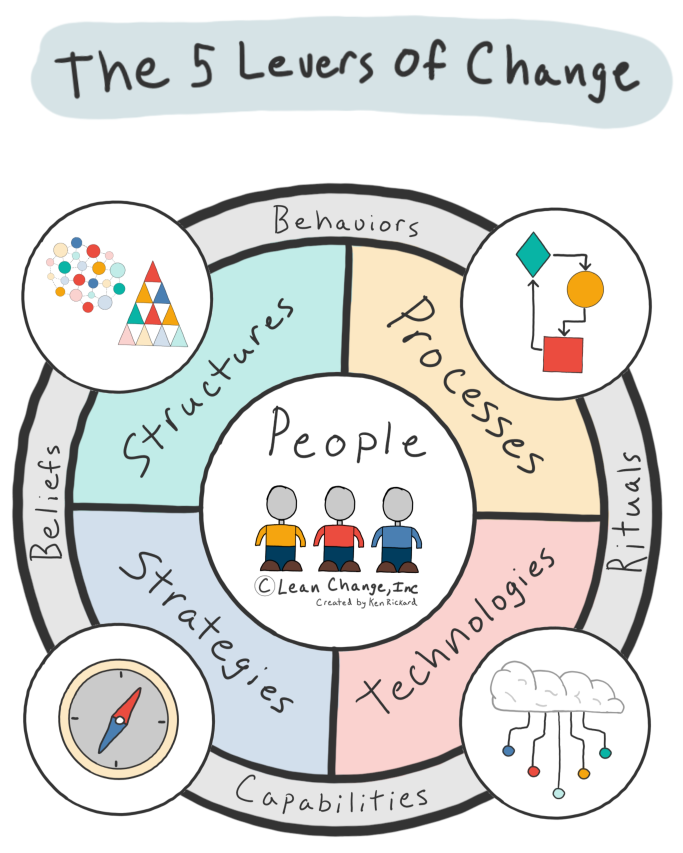
The five levers form a holistic map of a modern organization:
People (beliefs and competence)
Strategy (how we lead, learn, adapt, and compete)
Structure (how authority, information, and decisions flow)
Process (how work is delivered and governed)
Technology (the tools that multiply, or mute, human capability)
Signal Vs Noise
Signals (You’re Probably In The Right Model)
A transformation is “in progress,” but the results are surface-level and fragile.
The organization keeps changing tools and rituals, yet the same bottlenecks keep returning.
You can feel turbulence between teams, functions, or leaders, and nobody can name why.
People keep saying “culture,” but the real issue is decisions, constraints, and incentives.
Noise (Common Misreads And Traps)
Transformation by two levers: changing Process and Technology, declaring victory, and leaving Strategy, Structure, and People untouched.
Optimizing one lever without noticing the downstream effects on the others.
Treating the method of change as neutral. It is not. The method becomes part of the system.
The Five Levers
People
People are the center of the whole system, because every other lever is ultimately expressed through human belief and behavior.
In this model, People includes:
Consciousness (beliefs): what we assume is true about control, risk, customers, success, and each other
Competence (actions): what we can actually do (skills, habits, judgment, collaboration)
People are also where culture quietly lives:
Beliefs shape what feels “normal.”
Behaviors reveal what is actually normal.
Rituals (repeated behavior patterns) cement both.
Strategy
Strategy is the systemic design of how the organization leads, learns, changes, and competes.
It is how the organization:
Leads (how direction and accountability are created)
Learns (how it senses and responds)
Changes (how it adapts, optimizes, and evolves)
Competes (how it shows up in its markets and industries)
Strategy is not just a plan. It is the organization’s default playbook for surviving reality, especially when reality refuses to cooperate.
Structure
Structure is how the organization is built to operate day to day:
reporting lines and team design
policies and constraints
decision-making constructs
information-sharing constructs
Structure is where beliefs become architecture. If the structure assumes “control equals safety,” it will naturally centralize decisions and restrict information, no matter how many posters say “empowerment.”
Process
Process is how work moves:
how work is delivered
how work is governed
how work decisions are made
Processes shape behavior at scale. If the process is predictive and rigid, it encourages compliance. If the process is discovery-oriented, it encourages learning. Either way, process makes behavior repeatable.
Technology
Technology is the tooling that supports, or substitutes for, work and collaboration:
software to build and test
tools to govern and collaborate
the software and hardware stack that supports delivery
Technology is a multiplier, sometimes of effectiveness, sometimes of dysfunction. A classic failure mode is using tools to replace human dialogue rather than enhance it. The tool becomes a social prosthetic that slowly amputates trust.
How To Use It In Your Role
Leaders
When you sponsor change, name which levers you are pulling on purpose.
If progress stalls, ask which lever is acting like the hidden constraint.
Watch for “two-lever transformations.” They create motion without movement.
Change Practitioners
Use the levers as a diagnostic, not a checklist.
Map what is already changing.
Identify what is not changing, or what the system is actively resisting.
Look for turbulence. Turbulence often shows up where one lever is being pulled and the others are misaligned.
Team Leads And Managers
Translate Strategy into local clarity. What can teams decide without escalation.
Name the structural constraints that make good work hard.
Treat Process as behavior design, not ceremony design.
Individual Contributors
Notice where work gets stuck. Is it approvals, priorities, unclear ownership, or missing capability.
Offer two suggestions: one that improves the current system, and one that challenges an assumption.
Pay attention to the rituals your team repeats. Those rituals are teaching the culture.
Personal Life
This lens transfers because families, teams, and communities are nested human systems.
People: beliefs, emotions, skills, and the capacity to repair after conflict
Strategy: how you decide what matters, especially under stress
Structure: roles, boundaries, and how decisions get made
Process: routines, agreements, and the “how we do things here” patterns
Technology: the tools that shape attention, coordination, and trust
A practical prompt: “Am I trying to fix the routine when the real lever is the boundary, or the belief underneath it?”
What This Looks Like In The Wild
An organization adopts Scrum and rolls out Jira. Delivery looks better for a moment.
Then the system snaps back. Priorities still change weekly. Decisions still bottleneck with a few leaders. Teams are still rewarded for local optimization.
The levers make the problem visible:
Process and Technology changed.
Structure (decision rights and constraints) did not.
Strategy (how learning and prioritization work) did not.
People are now living inside mixed signals, so trust erodes.
The next move is not more tooling. It is aligning the other levers so the new way of working can actually survive.
Related Big Ideas
The 2 Change Strategies Of Effective Organizations (how to choose which kind of change you are making)
The 4 Dimensions Of Change (where change must land to stick)
The 5 Waves Of Transformative Change (how transformation unfolds over time)
Closing Thought
The levers are not a step-by-step recipe. They are a way to see what is really changing, what is not changing, and what to move next.