The 5 Waves Of Transformative Change
The Core Idea
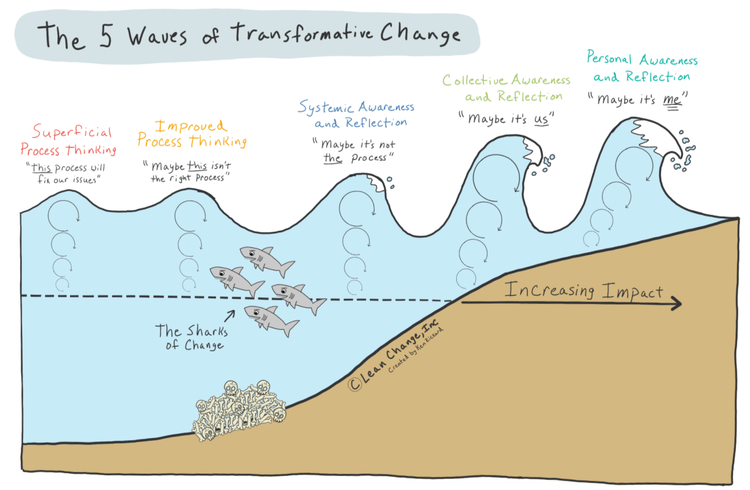
Transformative change rarely deepens in a straight line. It tends to arrive in waves.
Early waves focus on visible changes like process and tooling. Later waves go deeper into how the organization thinks, makes sense, and develops people.
If You Remember Nothing Else: The deeper the wave, the greater the impact. The deeper the wave, the more it asks people to change how they see the system and themselves.
The Model
The five waves describe a typical progression:
First, we change what we do.
Then, we notice the system we live inside.
Then, we notice ourselves inside that system.
A key caveat: waves are not perfectly sequential. Real change can loop, overlap, move backward, and surge forward.
Signal Vs Noise
Signals
You may be stuck in a wave when you hear patterns like these:
"We changed the process, so why is nothing better?"
"Let’s try another method."
"The teams are working hard, but the organization keeps getting in the way."
"We fixed the org chart, yet the same dynamics keep returning."
"Maybe the issue is how we are showing up."
Noise
Common traps that create change theatre:
Treating a complex system like it will respond to a simple tweak.
Swapping methods without reflecting on why the last one did not land.
Trying to solve systemic issues with slogans, dashboards, and new ceremonies.
Calling frustration resistance instead of treating it as data.
The Five Waves
Wave One: Superficial Thinking
"Let’s do Scrum."
This wave is the belief that a simple change will fix the problem.
What It Looks Like:
A single practice becomes the solution.
Success is expected quickly.
Discomfort is interpreted as people not trying hard enough.
What Helps Here:
A small, honest experiment with fast feedback
Clear intent for what is being improved
What Makes It Worse:
Pretending the system is simple
Scaling a practice before learning what it changes
Wave Two: Improved Superficial Thinking
"Crap, that didn’t work. Maybe we should be using Kanban instead."
This wave is a smarter version of Wave One. The method changes, but the depth does not.
What It Looks Like:
Another framework is adopted.
Better vocabulary, similar results.
The system keeps snapping back after the initial boost.
What Helps Here:
Reflection that asks, "What did we assume would happen?"
Noticing the constraints that the method cannot touch
What Makes It Worse:
Tool and process hopping
Measuring activity instead of outcomes
The Change Sharks
Just offshore are the change sharks. They keep people and organizations from moving beyond superficial change.
Jumping the change sharks requires reflection and development. It requires evolving vertically so more people can see the system, not just operate inside it.
Wave Three: Systemic Awareness And Reflection
"Our delivery processes can’t work because of how the organization works. The organization is an impediment."
This wave is the realization that the system is shaping outcomes.
What It Looks Like:
People see how hierarchy, decision paths, incentives, and information flow shape behavior.
Bottlenecks become visible as system properties, not individual failures.
The hard part is that many people who most need systemic awareness cannot see the problem from their position.
What Helps Here:
Mapping how decisions actually move
Making constraints visible, then adjusting them
What Makes It Worse:
Blaming teams for outcomes created by structure
Fixing local delivery while the system stays unchanged
Wave Four: Collective Awareness And Reflection
"We’re addressing organizational impediments, but things aren’t improving."
This wave is when the organization realizes that changing structure and process is still not enough.
What It Looks Like:
The system becomes more aware of itself.
Collective self awareness starts spreading beyond a small group of change agents.
A movement for change begins to form.
What Helps Here:
Shared reflection practices across leadership and teams
Honest conversations about values, fear, and control
What Makes It Worse:
Treating culture as posters instead of patterns
Installing new governance without changing how people relate and decide
Wave Five: Personal Awareness And Reflection
"Maybe it’s not everyone else or the system. Maybe it’s me."
This wave is personal reckoning. Individuals accept their own patterns and limitations and develop greater self awareness.
What It Looks Like:
People become more introspective and less defensive.
Leaders reduce blame and increase curiosity.
The change becomes less about programs and more about who people are becoming.
What Helps Here:
Reflection that connects personal patterns to system outcomes
Development practices that build conscience and competence
What Makes It Worse:
Staying in superficial waves while claiming deep transformation
Treating people as resources to be managed rather than humans who evolve
How To Use This In Your Role
Leaders
Ask which wave you are in before you choose what to do next.
Be cautious about long term plans and fixed metrics early on.
Sponsor deeper waves by changing decision constraints and investing in development.
Change Practitioners
Use the waves as a diagnostic when progress stalls.
Design interventions that match the wave rather than forcing depth too early.
Help people jump the change sharks through reflection and skill building.
Team Leads And Managers
Translate the wave into day to day reality for your teams.
Surface where the system blocks flow, clarity, or safety.
Protect learning loops so the change can adapt instead of rigidify.
Individual Contributors
Notice when a method is being treated as the answer.
Share what the system is doing to the work, without blame.
If you feel stuck, ask what wave you are actually in.
Personal Life
The waves show up in personal change too.
Early waves look like changing routines or tools.
Deeper waves look like noticing the system you live in and the patterns you bring to it.
A practical prompt: "Am I trying to swap methods, or am I ready to change how I see the situation?"
Tiny Example
A company rolls out a new delivery method. Velocity improves for a few weeks, then slows. Leaders respond by switching tools and tightening reporting.
A wave read:
Waves one and two are active. Methods are changing, but the depth is not.
The constraint is systemic. Decisions are slow, incentives reward local optimization, and information is filtered.
A better next move is to stop swapping methods and move into systemic awareness by mapping decision paths, shifting constraints, and running small experiments to change how authority and information flow.
Related Big Ideas
The 2 Change Strategies Of Effective Organizations (how to choose optimization or evolution)
The 5 Levers Of Change (what to move when a wave stalls)
The 3 Agilities Of Effective Organizations (how leadership, change, and delivery reinforce each other)
Closing Thought
Waves are not a judgment. They are a pattern.
When you can name the wave you are in, you can stop treating turbulence like a surprise and start choosing the next move with intention.